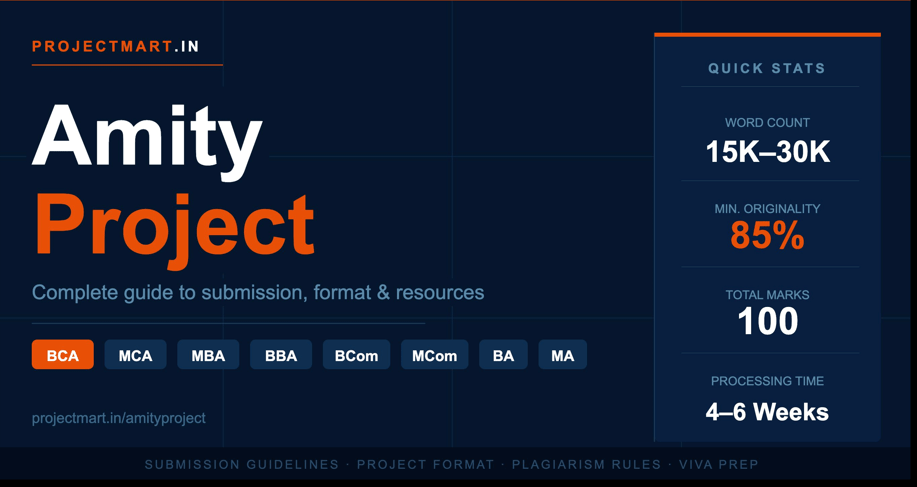

Most articles about the Amity Project cover the obvious — word count, formatting, plagiarism. But the Viva is the section that catches students most off guard, and the evaluation scheme is the thing students understand least clearly before they start. This guide focuses on what gets you the full 100 marks: understanding how you are evaluated, how to prepare for the Viva, and the submission tips that experienced students rely on.
How the Amity Project is Scored
The total marks breakdown is:
- Project Report: 70 marks
- Viva: 30 marks
- Total: 100 marks
What this means practically: even a technically excellent project report can result in an overall poor grade if the Viva is not prepared for. Conversely, a solid Viva performance can lift an above-average project report to a top score. Treat both components with equal seriousness.
What Are the Viva Questions?
The Viva for the Amity Project consists of 5 descriptive questions. These are not generic — they are generated specifically based on your submitted project. Questions typically probe:
- Your research methodology — why you chose your design, sampling, and analysis approach
- Your literature review — which key authors or studies informed your work and why
- Your results — what your data shows and whether it supports your hypotheses
- Your recommendations — what you would advise based on your findings
- Your implications — what your project contributes to theory or practice in your field
Viva questions become accessible only after your full project file is uploaded. This is intentional — Amity designs questions based on your specific content, making it impossible to prepare without actually writing your project.
Viva Preparation: 5 Steps That Work
Step 1 — Re-read your entire project before answering Viva questions.
This sounds obvious but is frequently skipped. Every Viva question references your specific content. Familiarity with your own work is non-negotiable.
Step 2 — Write out your methodology rationale in your own words.
Why did you choose a descriptive design? Why convenience sampling? Why a questionnaire over interviews? Being able to articulate the “why” of every methodological choice is essential.
Step 3 — Summarize your literature review in 3–5 key arguments.
Viva questions often ask about the most significant prior research in your area. Know who wrote the key papers, what they argued, and how they relate to your study.
Step 4 — Know your numbers.
If your project uses quantitative data, be able to state your key findings from memory — sample size, key statistics, hypothesis outcomes. If qualitative, know your key themes.
Step 5 — Prepare your recommendations and implications clearly.
The “so what” of your research is what Amity is ultimately evaluating. What should organizations, policymakers, or professionals do differently based on your findings?
Programme-Specific Amity Project Resources
Before you begin writing, access project resources aligned to your programme through ProjectMart’s Amity Project portal:
- Amity BCA Project — Computer Applications
- Amity MCA Project — Advanced IT and Computer Science
- Amity MBA Project — Business Administration
- Amity BBA Project — Undergraduate Business
- Amity BCom Project — Commerce and Finance
- Amity MCom Project — Postgraduate Commerce
- Amity BA Project — Arts and Humanities
- Amity MA Project — Postgraduate Arts
Top Submission Tips From Students Who Got It Right
Start the extended abstract early.
Many students write the extended abstract last, treating it as a summary. This is backwards. Write it early as a planning document — it forces you to define your hypotheses, methodology, and expected results before you write the full project.
Use a plagiarism checker before final submission.
Do not wait for Amity’s plagiarism check to tell you there is a problem. Run your draft through Turnitin, iThenticate, or a comparable tool. Aim for 88–90% originality to give yourself a buffer above Amity’s 85% minimum.
Do not skip the student certificate.
The signed and scanned student certificate — certifying the work is original and not previously submitted — is frequently forgotten. It is mandatory. Missing it triggers a full resubmission request.
Confirm your Project Guide qualifications before you begin.
Your Project Guide must be a postgraduate with 10+ years of experience. Confirm this before you ask them to supervise — finding out mid-project that your guide does not qualify is a serious setback.
Answer the Viva questions thoroughly.
Viva answers should be detailed and specific to your project. Generic answers that could apply to any project score poorly. Use your actual data, your specific methodology, and your own conclusions in every answer.
See also: How Retail Installation Companies Help Stores Launch Faster
The Bottom Line
The Amity Project is the most substantial academic requirement of your Amity University Online degree. Approached correctly — with the right topic, a compliant Project Guide, an original well-formatted report, and thorough Viva preparation — it is entirely achievable and genuinely valuable. For complete project support — originally written, properly formatted, and course-specific — visit www.projectmart.in/amityproject today.


 By
By